February 20, 2013

Iwo Jima - "The birth of a new freedom for the sons of men everywhere"

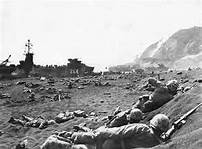
There have been plenty of reminders the past few days about the 68th anniversary of the Battle of Iwo Jima, but an old friend of mine passed along another reminder...one about the extraordinary eulogy given by Rabbi Roland B. Gittelsohn, a Navy Chaplain with the 5th Marine Division, at the dedication of the Division cemetery on Iwo, March, 1945. It is often referred to as second only to the Gettysburg address in its power, poetry, timeless message of love and compassion for one's fellow man, and commemoration of both the nobility and terrible loss that accompanies battle. Here it is as it was read into the U.S. Congressional record not too long ago:

"Here before us lie the bodies of comrades and friends, men who until yesterday or last week laughed with us, joked with us, trained with us, men who fought with us and feared with us. Somewhere in this plot of ground there may lie the man who could have discovered the cure for cancer. Under one of these Christian crosses or beneath a Jewish Star of David, there may now rest a man who was destined to be a great prophet, to find the way perhaps for all to live in plenty, with poverty and hardship for none. Now they lie here silently in this sacred soil, and we gather to consecrate the earth in their memory.

"It is not easy to do so. Some of us have buried our closest friends here. To speak in memory of such men as these is not easy. No, our poor power of speech can add nothing to what these men have already done. All that we can even hope to do is to follow their example, to show the same selfless courage in peace that they did in war; to swear that by the grace of God and the stubborn strength and power of the human will, their sons and ours will never suffer these pains again. These men have done their job well. They have paid the ghastly price of freedom.

"We dedicate ourselves, first, to live together in peace the way they fought and are buried in this war. Here lie officers and men, Negroes and whites, rich men and poor, together. Here, no man prefers another because of his faith or despises him because of his color. Here, there are no quotas of how many from each group are admitted or allowed. Among these men there is no discrimination, no prejudices, no hatred. Theirs is the highest and purest democracy.
"Any man among the living who fails to understand that will thereby betray those who lie here dead. Whoever of us lifts up his hand in hate against a brother or thinks himself superior to those who happen to be in the minority makes of this ceremony and the bloody sacrifice it commemorates an empty, hollow mockery. To this, then, as our solemn, sacred duty, do we the living now dedicate ourselves to the rights of Protestants, Catholics, and Jews, of white men and Negroes alike, to enjoy the democracy for which all of them have paid the price.

"When the last shot has been fired, there will be those whose eyes are turned backward, not forward, who will be satisfied with wide extremes of poverty and wealth in which the seeds of another war can breed. We promise you, our departed comrades, this too we will not permit. This war has been fought by the common man. Its fruits of peace must be enjoyed by the common man. We promise, by all that is sacred and holy, that your sons, the sons of miners and millers, the sons of farmers and workers, the right to a living that is decent and secure.

"When the final cross has been placed in the last cemetery, once again there will be those to whom profit will be more important than peace. To those who sleep here silent, we give our promise: We will not listen. We will not forget that some of you paid the ultimate price for men who profit at your expense. We will remember you as you looked when we placed you reverently, lovingly, in the ground.

"Thus do we memorialize those who, having ceased living with us, now live within us again. Thus do we consecrate ourselves to the living to carry on the struggle they began. Too much blood has gone into this soil for us to let it lie barren. Too much pain and heartache have fertilized the earth on which we stand. We here solemnly swear, this shall not be in vain. Out of this, and from the suffering and sorrow of those who mourn this, will come, we promise, the birth of a new freedom for the sons of men everywhere."

Semper Fidelis


February 16, 2013

Living Off Our Children - Lying To Ourselves

I was recently asked to review the President's "State of the Union Address" (SOTU) for any specific implications for the U.S. Defense budget. I'd intentionally avoided watching it during the live broadcast because I knew I could skim all the news/commentary that would follow to gather the salient points and I had better things to do with my time than watch the political theater that is the SOTU. Given my task, however, I had to actually read the speech which only served to validate my decision to skip the live broadcast. That said, my project served as a useful mechanism to assemble a variety of budget-related items I've been tracking for some time. Most recently, of course, has been the flood of materials focused on the pending sequester. It seems more likely than ever that sequestration will occur, so the Defense Department has sent all the military Service Chiefs and various Defense officials to Capitol Hill to regale Members with their assessments of the effect sequestration will have on military readiness and national security. Short story - we're in for some very lean years, reduced military readiness, and a steep hill to climb should we ever need to mobilize forces in large numbers. (I'll work on a future post that gets into some of the detail on this subject.) 

All this aside, the SOTU address did underscore (unintentionally) why we have arrived at sequestration in the first place, why it is a relatively minor plot point in a much larger saga, and why commentators of various sorts have a rather dim view of our future days. It really comes down to this: our collective unwillingness to be honest with ourselves is sowing the seeds of our destruction. Our national budget, flights of fancy like the SOTU, Congressional ineptitude in matters of fiscal responsibility, the corrosive effect of hyper-partisan bickering, and the complicity of the American public in the massive fraud being perpetrated against future generations combine to make 'solutions' unlikely. Am I without hope? Of course not. Anything is possible and America has shown an amazing ability to overcome extraordinary challenges. But we are caught in a terrific current that is sweeping us to a very bad place and we seem unable to commit ourselves to the effort necessary to escape.

As part of my little project, I put together the above graphic to illustrate aspects of our budget situation and the relative amounts of various elements associated with the budget that hopefully provide perspective. The rancorous debate over "cuts" mandated by the sequester are the fiscal equivalent to arguing over who gets the bigger deck chair in which to relax while the ship is sinking under you. As written, the sequester requires a reduction in federal spending of $1 trillion over a ten year period, meaning $100M per year each year for the next decade. As written, 50% of the reductions are levied against Defense spending (with military personnel accounts exempted) while the other 50% is applied to all other spending. Consider, however, that our federal spending outpaces revenue by 50%, meaning we take in only two-thirds of what we spend (roughly: income=$2.3T, spending=$3.4T) so we go $1T further into debt every year. With this in mind, sequestration would lower the amount of money we're spending that we don't actually have from $1,000,000,000,000 to $900,000,000,000 per year.

Hmmm...I think that means we're still accumulating massive new debt each year. 

It also means the amount of money we have to spend to service that debt -- the interest paid on the debt -- increases over time. Add to this all the new promises we're making: health insurance coverage for pre-existing medical conditions; adding 11-15 million previously-illegal-immigrants to the pool of people eligible for government benefits; federal subsidies to 'green' industries; opting for more expensive energy technologies (wind, solar, biofuel, etc.) over less expensive coal and nuclear; funding 'high-speed rail' at phenomenal costs in dollar-per-passenger-mile...the list is quite long...and you quickly outpace the rate of anemic growth the commercial sector is experiencing. Not a pretty picture.

What should catch your eye, however, is the big arrow in the background showing 'total unfunded obligations.' This is the reality that things like sequester, policy speeches, federal budgets, and public demands completely ignore. The $80 trillion I used is a rough average of many estimates available for review ($62T, $84T, $100T, $144T to cite just a very, very few). Variations in estimates result from what one considers an 'unfunded liability." Most estimates center on the ever-increasing cost of health care insurance coverage. But as one includes deferred maintenance of national infrastructure, obligations associated with public sector pension plans, assumptions of future deficit spending, the cumulative effects of inflation and compounded interest on debt, etc. you can quickly reach extraordinary levels of debt that are implicit in our current spending patterns.

My favorite estimate comes from Niall Ferguson, a British economic historian who takes the same approach to analysis/commentary of economic policy that Victor Davis Hanson does with his commentary on socio-cultural and foreign-military affairs...approaches rooted in the lessons of history. Ferguson estimates that the total of 'unfunded liabilities' facing the U.S. amounts to a staggering $238 Trillion, basing his conclusion on the "difference between the net present value of federal government liabilities and the net present value of future federal revenues" plus the "unfunded liabilities of state and local governments". In an article of his entitled "Why the young should welcome austerity," published last summer, Ferguson makes some trenchant observations: 
     "These mind-boggling numbers represent nothing less than a vast claim by the generation currently retired or about to retire on their children and grandchildren, who are obligated by current law to find the money in the future, by submitting either to substantial increases in taxation or to drastic cuts in other forms of public expenditure.
     "In his Reflections on the Revolution in France, published in 1790, Edmund Burke wrote that the real social contract is not Rousseau's contract between the sovereign and the people or "general will", but the "partnership" between the generations.
     "Society," says Burke, "is indeed a contract. The state is a partnership not only between those who are living, but between those who are living, those who are dead, and those who are to be born."
     "In the enormous inter-generational transfers implied by current fiscal policies we see a shocking and perhaps unparalleled breach of precisely that partnership.
     "We blame the politicians whose hard lot it is to bring public finances under control, but we also like to blame bankers and financial markets, as if their reckless lending was to blame for our reckless borrowing.
     "We bay for tougher regulation, though not of ourselves."

Put another way, our inability to discipline our current 'wants' will not only bankrupt us in our present time, it will consign our children and their children, for generations to come, to lives lived in austerity...and it just doesn't have to be that way. We are methodically and relentlessly breaking faith within our generation, with those who preceded us (who built the wealth and opportunities implicit in our system that we are now squandering), and with those to come. The consequences will be much greater, more deeply penetrating and far broader in their scope than the price of gas at the pump or the availability of a doctor to tend an illness. They will include damage to the mutual trust and relationships, the implied societal framework of unspoken agreements, that undergird the success of a nation. Our government is incapable of addressing this problem. It will be up to the People. Do we have it within us?

February 11, 2013

Real Heroes


There isn't anything one can actually add to this story; I know I can only comment on it. It's a bit lengthy but if you take time to read anything this week, please read this. Movies, television, the 'web', water cooler stories all regale us with tales of derring-do, swashbucklers and secret agents who always hit their mark, survive all manner of explosions, rarely take a hit themselves, and come out the vaunted hero in the end. This tale sheds light on the gritty reality of real heroes...and one real hero in particular. Our political, entertainment, sports, and even business worlds are filled to overflowing with chest-thumping, attention seeking, wealth motivated egoists. This story talks about the type of men who go into harm's way for all the right reasons, do their job in the shadows, who shun the limelight, and for 'thanks' get a nice plaque and a pat on the back on their way out the door. This story speaks to the real cost of such service, a cost born not only by the man himself, but by his family as well. True professionalism in service to one's country calls upon people to sacrifice, to share great burdens others are unable or unwilling to shoulder, and to do what must be done even when...especially when...such acts go unnoticed, unacknowledged, and unrewarded in ways most people seek and expect. Yes, among those who share such service there is a bond and an understanding no one not of that circle can truly appreciate. But even with that type of brotherhood buoying the spirit, the true warrior must continue to should a great burden largely alone. It's the nature of the beast. This story reminds me of a observation always attributed to George Orwell: “We sleep safe in our beds because rough men stand ready in the night to visit violence on those who would do us harm.” Though he didn't actually say this, it makes a very important point. We are blessed that people like The Shooter are willing and able to undertake the tasks they do on our behalf. I just wish we did as good a job taking care of them as they do of us. I pray that his days ahead bring him and his family the peace he seeks. 

"The Man Who Killed Osama bin Laden... Is Screwed," By Phil Bronstein, Esquire Magazine

February 1, 2013

Women in Combat

A week ago, Secretary of Defense Panetta announced that he had decided to repeal the restriction on women serving in combat units. Stating the obvious, there were howls of derision and near-apocalyptic warnings on one side of the spectrum while at the other end long-time advocates for such a change cheered themselves hoarse. (A handy quick-reference source for a good sampling of the arguments pro- and con- can be found here.) Those in favor cited the American principles of 'equality' among people, 'equal opportunity' to serve one's country, and 'equal opportunity' to compete for promotion to the most senior levels of leadership within the military Services regardless of gender. Those opposed raised a host of issues from the physical ability to perform tasks associated with combat units, to whether 'unit cohesion' would be damaged by the introduction of women, the impact of readiness issues stemming from different biological traits (pregnancy, etc.), the frictions that accompany mixed-gender settings, and whether performance standards would be lowered to ensure women would 'succeed' even at the potential risk of lowering the combat effectiveness of a unit. 

From all the statements I've read issued by senior leaders in the Department (both civilian and military), I take it as a 'done deal' that women will indeed by allowed to serve regardless the findings of the various studies now underway in the Army and Marine Corps. The Administration has committed to making this happen and the Services will salute smartly and get it done. Personally, I think it's a very bad idea for reasons that include some of those already mentioned by critics but mostly for a reason I've not heard raised at all in the current debate. I've posted below some thoughts I shared with friends/colleagues earlier this week on this issue. Before jumping into it, however, I just want to be clear that I have the deepest respect for the women who do serve our country in uniform, whether in the military services, law enforcement, as firefighters, or other 'first responder' professions. In my three decades of service to our country, I have had the distinct honor of serving with or around some of the most capable and professional women imaginable. Whether here at home, while deployed aboard ship, or serving in combat zones abroad, the women Marines I've worked with more than held there own right alongside their male colleagues. But I hope you see the larger point I try to make below. Without further ado...
----
Secretary of Defense Panetta’s decision to open the “combat arms” career field to women has stirred a hornet’s nest of response both in vigorous support and horrified opposition. Having served a career in uniform as a U.S. Marine, in peace and war, and remained involved in the Defense community for several years since retiring I have my own thoughts on the matter. They derive from two pillars: maximizing effectiveness in combat (get the dirty job done as quickly and effectively as possible) and acknowledging in our policies what I think to be key values-based cultural issues. 

Women involved in combat actions incidental to war are one thing; committing women to offensive combat actions intentionally, especially in ground actions, is quite another...and I don't mean having them drive a truck along an IED-strewn road or conducting the myriad tasks necessary to sustain combat ops in a theater of action. Women have participated in "war" in one form or another as long as people have fought. They have certainly suffered the nastiest effects of war wherever it has occurred and have been at the forefront in 'cleaning things up' when all the shooting stops - getting a society back on its feet, dealing with the devastation imposed on families, shouldering the burden when the men don't come back from the front, etc. In my mind, there isn't any question about whether women can endure, or have endured, in such settings nor whether they have the ability to pull a trigger as well as any man or have the stamina to hold up under extended hours of hard work under arduous conditions. Examples abound across the field of human endeavor. Even in ground actions there have been notable examples. One of the most effective snipers in WWII was a Russian woman (one of over 2000 Russian women who served as snipers) who tallied an extraordinary toll of dead Germans (309). But is this really the point? For me, it isn't. The real point, in my mind at least, is how a society views warfare and the extent to which it willingly commits its population to undertake some of the most horrible tasks imaginable. 

In Spielberg’s classic film “Saving Private Ryan” there is this heart-wrenching scene in which one of the soldiers looking for Ryan finds himself engaged in a brutal hand-to-hand fight with a German soldier. He ends up dying as the German gets the upper hand and slowly shoves a big fighting knife into his heart. Most combat actions take place at extended ranges via rifle, artillery, and aerial-delivered fires. But the whole purpose for ground forces in war is to 'locate, close with, and destroy the enemy by fire and maneuver or repel his assault by fire and close combat.' At some point, it gets close and personal, and brutish, and very, very physical. 

Current cop shows on TV featuring 'hardened but vulnerable' female detectives and SWAT team members, news footage of young women serving in the 'front lines' in Iraq and Afghanistan, and the now-ubiquitous drone of 'drone ops' convey the sense that the combat-of-old just isn't the way it is in the 21st Century. Poppycock. Mankind has always searched for ways to 'touch the enemy' with effect and from increased distances. But mankind has also learned that ultimately it comes down to who owns the terrain and successfully imposes his will on his opponent. What our most brutal enemies will conjure-up is what will eventually happen on a battlefield - i.e. brutal treatment of a captured female for effect. Just look at the reporting out of Syria about rape being systematically used as a weapon. The same thing has occurred in other conflicts, of course, and is now occurring with nauseating regularity among the 'brush wars' raging in western Africa 

Various commentators have observed that cultures or countries can be assessed or judged by how they treat their women. Some societies dominated by “Islamic fundamentalists", for example, tolerate and even espouse beating their women and denying them the most basic rights, respect and dignity. That says something. What can be said for a culture that willingly and completely unnecessarily commits its women to the brutality of “waging war” on their fellow Man for the purpose of showing how 'equal and just’ we can be?

I'd prefer no one had to undertake the task. But history plainly shows that odious regimes and vile individuals arise from time to time that can only be stopped by force. Given this, I'd prefer to showcase our better cultural nature, apply as effectively as possible the resources (meaning 'people') best able to complete the job as quickly as possible, and thus bring the crisis to a close. "[Most] effectively", "best able", and "as quickly as possible" in such situations typically call for the aggressive application of violence against one's enemy when lesser measures fail...as they often do. Why lessen our odds for success, and trumpet as an “achievement”, that we’re happy to have even more of our society participate in the harsh, ugly practice of killing the enemy all for the goal of ‘leveling the career playing field’ or showing just how 'equal' we can be?

Whatever supposed gain we might achieve by the change in policy, I think we will have lost something much more important in this exercise. We won't notice it immediately, of course, but it will have an effect on who we are as a people.

January 30, 2013

Online Freedom

A couple of recent articles about 'online freedom' really grabbed my attention more than is normally the case when I scan such material. The first was a ZDNet post about the 'hack' of the U.S. Sentencing Commission website by the hacker-collective known as Anonymous. The second item was a very nice Op-Ed by Timothy Karr, published in the Seattle Times, in which he talks about the importance of protections needed to ensure the Internet remains what it has rapidly evolved to become: a globalized 'common good' like air, food, water and shelter.

'Online freedom' is such a complex, expansive, and nuanced issue that I'll not even attempt to fool myself into thinking I can do it justice in a brief blog post, but I do want to make a few observations.

First, 'the web' is probably that last domain or medium by/through which people can exchange information of any type, any where, at any time. It probably comes as close to 'unfettered freedom' in the public domain as one is likely to find in life and as such presents mind-boggling opportunity as well as enormous potential for harm. In a sense, it is the virtual-world/cyberspace analogy to what the U.S. has represented in the physical world to so many people for so many years. For multitudes, the U.S. has represented the idea that anyone has the opportunity to do anything, that in this country one has the freedom to pursue any dream...not the guarantee of an outcome, mind you, but the freedom to try. With that freedom, however, come 'vulnerability' and 'risk' and the very real potential to 'fail.' Every attempt to eliminate risk, to guarantee an outcome, or to reduce vulnerabilities to near-zero, however, necessarily means that controls over behavior must be effected, that efforts must be shaped and managed, and that comparative differences be 'normalized' such that one person or group does not have an inherent advantage over another. When freedom is maximized, there will always be winners and losers. But when controls are imposed to erase such disparity, freedom is sacrificed. All freedoms carry this inherent dichotomy. 'Freedom of speech' means equal freedom to praise as well as condemn, for a society to be able to express opposing views without fear of persecution. Freedom to 'arm and defend oneself' means your neighbor can have a gun, too. 

I do not propose that all freedoms are perfect in their implementation. As our own legal system has determined here in America, and we have wholly embraced, 'freedom of speech' does not mean the freedom the shout 'Fire' in a crowded theater because of the real danger of causing irreparable physical harm to others. But herein lies the rub: when 'freedom' bumps up against things like 'intellectual property', 'public good' (or safety), the inherent obligation of government to exercise its lawful responsibility to provide for various protections, etc., etc. These are in constant tension--the freedom to do vs. necessary constraints on activity to guard from excessive harm. In the midst of this, of course, are issues such as 'personal responsibility', 'individual restraint', 'willingness to accept risk' (and the natural and/or logical consequences of such risk), and protection of the weak against the predations of the strong.

Second, 'online freedom' is arguably the greatest tool in the eternal fight against repression, corruption, intimidation and criminality whether practiced by governments, corporations, criminal organizations, or private groups and individuals. We value a 'free press' because a responsible press corps has the ability to bring corrupt practices into the light of public visibility and thereby enable the public to hold officials of all types accountable for their actions. Social media tools such as Facebook and Twitter enable people to share information, collaborate on projects, and bring to public awareness all manner of issues. Much of it is inane, of course, but much of it is immensely good too.

Which leads me to a third point, that of the importance of not only protecting online-freedom but of promoting it even when problems are encountered. (When an issue is important enough - like recognizing the inherent right to maintain ownership and control of one's creative work - we find ways to protect such things without destroying the larger good that comes from sustaining the underlying freedom or right.) As I mentioned above, governments have an obligation to undertake tasks individual citizens or even a collected whole cannot do on their own, such as defending a country from invasion or establishing and maintaining a legal framework within which a society conducts business. But all too often governments abuse their power, exploiting their ability to draft and impose laws and rules, to compel compliance, and to effect punishments against which an individual citizen or minority group has little defense. In such cases, the Internet affords people the ability to share information about, raise awareness of, and mobilizing opposition against such corruption. 

Governments know this. Repressive, authoritarian regimes fear it. Examples abound but two that are regularly cited are the efforts by China and Iran to stifle dissent and prevent collective action by censoring the free exchange of information among their populations through control of the Internet within their borders.

It is sometimes observed that people should be mindful when they hear of efforts by one group to control another even in small things or when long-held 'rights' are lessened even a little, because once a precedent for such has been established and it becomes the 'new normal' it doesn't take as much effort to nibble away the next little chunk. At some point, the once-unassailable 'right' or 'freedom' is gone and people wonder how it all happened.

You might remember some reporting about our own fight here in the U.S. over this issue about a year ago. A couple of bills had been introduced into Congress for debate that would have placed restrictions on content and the exchange of information across the internet. A massive effort was mobilized by 'online freedom' advocates and a range of companies with both idealistic and capitalistic reasons for preventing their passage. Personally, I'm glad the freedom-advocates won.

In closing, let's return for just a brief moment to the hack perpetrated by Anonymous. I don't know much about the group but I found their manifesto quite interesting for a couple of reasons that include their commitment to 'net freedom' (and willingness to confront attacks on such) as well as insight into the strange new world dawning upon us in the form of high-level competitions waged in cyberspace, with all the implications we are only on the verge of beginning to understand. 

This evolving world is becoming our 'new normal'. I think it is incumbent upon all of us to understand these issues, to jealously guard our freedoms, and to make sure that those who have the ability (legally or technologically) to impose restrictions, controls, and limitations on such clearly understand that they are being watched and will be held accountable in the public domain for their policies and actions both here at home and in so many countries around the world where our freedoms remain a dream yet to be realized.

January 18, 2013

Passages and Perspectives


This coming Monday, our Country will observe the inauguration of our recently elected President. I can't help but think of previous inaugurations and what they have represented singularly in their own time and collectively across the fifty-six inaugurations that have preceded this one upcoming. I also can't help but draw comparisons. Take a few minutes to read Reagan's First Inaugural Address, noting what he emphasized, the sparing use of personal pronouns (and their specific context when used), his focus on the greatness of our country and the elements he believed made it great, and his prescription for the ills that plagued the U.S. as he took office. On Monday, do the same analysis. I think the differences will be stark.

Inaugural Address, Ronald Reagan
January 20, 1981 

Senator Hatfield, Mr. Chief Justice, Mr. President, Vice President Bush, Vice President Mondale, Senator Baker, Speaker O'Neill, Reverend Moomaw, and my fellow citizens:

To a few of us here today this is a solemn and most momentous occasion, and yet in the history of our nation it is a commonplace occurrence. The orderly transfer of authority as called for in the Constitution routinely takes place, as it has for almost two centuries, and few of us stop to think how unique we really are. In the eyes of many in the world, this every-4-year ceremony we accept as normal is nothing less than a miracle.

Mr. President, I want our fellow citizens to know how much you did to carry on this tradition. By your gracious cooperation in the transition process, you have shown a watching world that we are a united people pledged to maintaining a political system which guarantees individual liberty to a greater degree than any other, and I thank you and your people for all your help in maintaining the continuity which is the bulwark of our Republic.

The business of our nation goes forward. These United States are confronted with an economic affliction of great proportions. We suffer from the longest and one of the worst sustained inflations in our national history. It distorts our economic decisions, penalizes thrift, and crushes the struggling young and the fixed-income elderly alike. It threatens to shatter the lives of millions of our people.

Idle industries have cast workers into unemployment, human misery, and personal indignity. Those who do work are denied a fair return for their labor by a tax system which penalizes successful achievement and keeps us from maintaining full productivity. 

But great as our tax burden is, it has not kept pace with public spending. For decades we have piled deficit upon deficit, mortgaging our future and our children's future for the temporary convenience of the present. To continue this long trend is to guarantee tremendous social, cultural, political, and economic upheavals.

January 17, 2013

"Customs, Traditions and Moral Values"

Sometimes a commentator publishes something that just doesn't need embellishment. Such is the case, in my opinion, with Walter William's latest item at Townhall.com. Though he references the current hullaballoo over gun ownership, he does so only to discuss the much more fundamental issue of societal restraints and where it comes from. If we are to find solutions to our problems, the first place we should be looking is the foundational underpinning for our culture, our form of government, and the societal framework that provided critical limits and reference points for what was acceptable in daily living. Without such a framework or foundation, we give license to our worst inclinations and suffer the consequences. 

Oh...and by way of illustrating Mr. Williams' article, I found this interesting little item originally published in the NY Times of all places, Jan 7, 1913. My, how the "Times" have changed!
Walter E. Williams 

When I attended primary and secondary school -- during the 1940s and '50s -- one didn't hear of the kind of shooting mayhem that's become routine today. Why? It surely wasn't because of strict firearm laws. My replica of the 1902 Sears mail-order catalog shows 35 pages of firearm advertisements. People just sent in their money, and a firearm was shipped. 

Dr. John Lott, author of "More Guns, Less Crime," reports that until the 1960s, some New York City public high schools had shooting clubs where students competed in citywide shooting contests for university scholarships. They carried their rifles to school on the subways and, upon arrival, turned them over to their homeroom teacher or the gym coach and retrieved their rifles after school for target practice. Virginia's rural areas had a long tradition of high-school students going hunting in the morning before school and sometimes storing their rifles in the trunks of their cars that were parked on school grounds. Often a youngster's 12th or 14th birthday present was a shiny new .22-caliber rifle, given to him by his father.

Today's level of civility can't match yesteryear's. Many of today's youngsters begin the school day passing through metal detectors. Guards patrol school hallways, and police cars patrol outside. Despite these measures, assaults, knifings and shootings occur. According to the National Center for Education Statistics, in 2010 there were 828,000 nonfatal criminal incidents in schools. There were 470,000 thefts and 359,000 violent attacks, of which 91,400 were serious. In the same year, 145,100 public-school teachers were physically attacked, and 276,700 were threatened.

What explains today's behavior versus yesteryear's? For well over a half-century, the nation's liberals and progressives -- along with the education establishment, pseudo-intellectuals and the courts -- have waged war on traditions, customs and moral values. These people taught their vision, that there are no moral absolutes, to our young people. To them, what's moral or immoral is a matter of convenience, personal opinion or a consensus.

During the '50s and '60s, the education establishment launched its agenda to undermine lessons children learned from their parents and the church with fads such as "values clarification." So-called sex education classes are simply indoctrination that sought to undermine family and church strictures against premarital sex. Lessons of abstinence were ridiculed and considered passé and replaced with lessons about condoms, birth control pills and abortions. Further undermining of parental authority came with legal and extralegal measures to assist teenage abortions with neither parental knowledge nor consent.

Customs, traditions, moral values and rules of etiquette, not laws and government regulations, are what make for a civilized society. These behavioral norms -- transmitted by example, word of mouth and religious teachings -- represent a body of wisdom distilled through ages of experience, trial and error, and looking at what works. The importance of customs, traditions and moral values as a means of regulating behavior is that people behave themselves even if nobody's watching. Police and laws can never replace these restraints on personal conduct so as to produce a civilized society. At best, the police and criminal justice system are the last desperate line of defense for a civilized society. The more uncivilized we become the more laws that are needed to regulate behavior.

Many customs, traditions and moral values have been discarded without an appreciation for the role they played in creating a civilized society, and now we're paying the price. What's worse is that instead of a return to what worked, people want to replace what worked with what sounds good, such as zero-tolerance policies in which bringing a water pistol, drawing a picture of a pistol, or pointing a finger and shouting "bang-bang" produces a school suspension or arrest. Seeing as we've decided that we should rely on gun laws to control behavior, what should be done to regulate clubs and hammers? After all, FBI crime statistics show that more people are murdered by clubs and hammers than rifles and shotguns.

January 16, 2013

It's gotta be one heck of a dented can!


"We can evade reality, but we cannot evade the consequences of evading reality"

One of my favorite quotes, perhaps because it's pithy and so wonderfully applicable across such a wide swath of issues. These days it seems most applicable to all things 'government.' I have several posts in draft-form that I hope to complete soon and I know I'll be referring to Rand's statement-of-the-obvious throughout them...not explicitly, perhaps, but certainly as a foundational theme.

The news is just chock-full of absurdities that reveal to the point of dismay the willful and wholesale evasion of reality in the absurd theater that passes for policymaking in Washington. I say 'willful' because the folks at the top of the political pile are not stupid. They know the ugly reality of our situation. They have unfettered access to all the information produced by our system and the wealth of lessons handed down from history. But in every instance, it seems, they choose to evade reality as they make promises that cannot be kept (and everyone knows it), set idealized objectives that cannot be attained (and everyone knows it), and swathe their agendas in the noblest-sounding rhetoric when most people have the sense to know they're being sold a bill of goods. They play 'we the people' for fools. But you know the really sad part? Too large of portion of 'we the people' play the game too. Knowing full well the consequences of evading reality, they not only buy the bill of goods, they buy it on credit!

This latest wrangling over sequestration, increasing revenue ('higher taxes' in plain-speak), and cuts to spending (which actually means decreasing only slightly the amount we are still over-spending) reminds me of the old story about two fleas fighting over who owns the dog; an irrelevant argument since neither flea has the slightest ability to exercise the control he arrogantly thinks he has. Just consider: the two parties can't reach agreement on reducing spending by $1 trillion over ten years, meaning, in reality, a 'measly' $100 billion less spending per year -- somewhat irrelevant when we are increasing our debt by over a trillion dollars every year!

All of which reminds me of another wonderfully apropos quote...

"And what would you do with a brain if you had one?"

January 6, 2013

Fiscal Cliff? Nope. Liability Falls? Yep.


I don't know about you but I am certainly comforted by the apparent fact that our national fiscal problems really aren't problems after all. Cliff? Pshaw! Based on policies emanating from Washington it appears it is more a gently sloping field of poppies...you know just like that heartwarming scene in The Wizard of Oz where Dorothy, the Cowardly Lion, the Tin Woodsman, and the Scarecrow are skipping along, enjoying the day on their way to the magical Emerald City where they hope to find the Wizard who can solve all their problems. 

Come to think of it...a little girl who is lost and trying to find her way, a lion without courage, a tin man without a heart, and a scarecrow without a brain all skipping along full of unbridled optimism through a field of pretty little flowers seductively lulling them into a fatal sleep... Maybe that IS the best picture of our current situation!

Back in the real world, Mortimer Zuckerman penned a good piece in a recent issue of U.S. News and World Report that is a pretty easy 'read' while still imparting the magnitude of the debt problem we are facing. A few extracts to set the stage:
  • Today the estimated unfunded total [debt] is more than $87 trillion, or 550 percent of our GDP. And the debt per household is more than 10 times the median family income.
  • Today, less than 40 percent of our budget is actually decided by Congress and the president, down from 62 percent 40 years ago. [the larger percentage is comprised of obligations or 'non-discretionary expenses' such as interest payments, social security, etc.]
  • Merely to avoid going deeper into debt, to cope with the speed at which compound interest is growing the real debt annually, we would have to collect $8 trillion in taxes each year...And here's the nub of it: All individuals filing tax returns in the country with incomes over $66,198 have a total adjusted gross income of about $5.2 trillion. The total corporate taxable income (at its peak in 2006) amounted to $1.6 trillion. This means that we have a maximum of roughly $7 trillion available if the government confiscated the entire gross income of individuals and corporations—not nearly enough to cover the yearly growth of U.S. liabilities. [emphasis added]
While this should be sufficient to raise at least an eyebrow or two -- "hey, Dorothy, I'm starting to feel really, really sleepy" -- it doesn't really address the 'how' of how we got here nor does it provide insight into the various forces in play that have effected and will continue to effect our situation.

This item, The Real Cliff, by Christopher Demuth (The Weekly Standard), however, does. It's the best article I've read on this topic. If you have any interest at all about the true nature of the fiscal problem our country is facing, please take the time to read this. It runs three and a half pages in print (in the magazine) but it's well worth your time, I assure you. 

Obviously I've had some fun with metaphors taken from the Wizard of Oz but the waterfall picture is much, much more apropos. The way I see it, a cliff is a static situation. The cliff is just 'there.' The only way one call fall over the edge (presuming you aren't pushed) is to walk to the lip and either lose your balance, have ground give way, or willingly leap to one's death. America isn't being 'pushed' by anyone, neither are we 'losing our balance.' If any 'ground is giving way' I guess one could make the case our economy is collapsing underneath us and that we are somehow powerless to stop it...but I just don't buy that. Are we willingly leaping to our death? 

In contrast, a waterfall is fed by a river that reaches a 'cliff' and flows on over. Rivers have currents that gather speed and strength. They have rocks and shoals and eddies and deep smooth runs and branches that feed in and lead away. They are formed by a myriad little rivulets that emerge from springs and are fed by runoff from surrounding terrain, that combine into a rushing torrent of water that proves to be extraordinarily resistant to change and difficult to emerge from. If you wait too long and get to near the falls, you're pulled over the edge regardless of any effort you make to escape. 

As Demuth so wonderfully, or sadly, points out we are very far downstream and rapidly approaching a fall that we may not be able to escape unless we somehow find the ability to exert herculean efforts to avoid. Some paraphrased highlights from his article:
  • America's de facto fiscal policy since the early 1960s: continuous government borrowing to pay for current consumption.
  • The Keynesian proposition in the context of practical politics...government officials, weighing current revenues and expenditures, should weigh the needs of the known present against the resources of an imagined future. But the present is always cluttered with problems and difficulties, while the future is an abstraction. 
  • It [has] turned out that the public's tolerance for high debt and deficits was much larger than anyone had supposed. Today, one would have to say that tolerance is unlimited so long as the public is faced with abstract numbers in newspaper headlines rather than tangible consequences.
  • Generational accounting suggests that future generations will be paying nearly all of their lifetime income in taxes, which obviously cannot happen...the real harm of financing current consumption with ever-increasing public debt [is that substantial] segments of the population become accustomed to levels of government benefits that cannot be sustained.
The herculean effort required in our current situation? Congress must gather the courage to say 'no' -- to the President, to constituents, to their own careers if necessary -- and lay-out to the public the reality of our situation while the public must realign its expectations with fiscal realities. If this doesn't happen, and very soon, then we're all going over the falls together.

I hope Glinda shows up soon!

The Rock

In the mid-1990s, I had occasion to visit Gibraltar, that small peninsula jutting out from Spain into the Mediterranean and which helps marks the strait that separates Europe from North Africa. It was ceded to Britain in 1713 following its capture nine years earlier during the War of the Spanish Succession. The Brits keep the face of 'the Rock' brightly illuminated at night in part to showcase its dramatic appearance but more likely, I think, as a way to thumb its nose at the Spanish who still argue for its return even after 300 years. Legend has it that Gibraltar will remain under British Rule as long as its famed monkeys remain. I've read that during WWII Churchill ordered additional monkeys imported from northern Africa when their numbers dwindled to just a half-dozen or so!

One of the things that struck me most during the trip (aside from an awesome portion of 'tasty cod, caught fresh this morning' served up by a local fish-n-chips shop owner) was a mosque under construction at that time on the southernmost tip of the peninsula. The Ibrahim-al-Ibrahim Mosque was completed in 1997, built as a "gift" by King Fahd of Saudi Arabia at a cost of approximately $8 million. Intended to serve the 2000 Muslims who comprise 4% of Gibralter's population, it is reportedly one of the largest mosques in a non-Muslim country. You can see its location here.

Over the past decade there has been a steady, and steadily increasing, amount of reporting about the spread of Islam across Europe and its displacing (or perhaps subduing) the traditional cultures and beliefs of Europe. Since 9-11 there has been a parallel uptick in reporting about the equally steady decay in the national identities of European nations and the erosion of much of what defined 'Europe' to the rest of the world. Though the causes for this are many and varied, most of the discussion with which I'm familiar attributes this shift to a few 'baskets' that include: an increase in materialism and secularism following the Second World War, the collapse of the Catholic Church as a central influence, the rise of the United States as the dominant power among Western countries (implying that the old countries of Europe receded from the global stage), and the emergence of 'globalism' as a defining characteristic of of an increasingly connected world with the resulting profound shift of capital and manufacturing away from Europe to other corners of the globe. As Europeans lost their place of preeminence they turned inward; freed of the cost of their own defense (the U.S. picking up the tab) their governments were able to devote huge sums to social programs upon which the people came to depend (and to demand); and as social stigmas--the moderating frameworks for social values--were eliminated, institutions such as "the Church" were increasingly viewed as close-minded anachronisms of a bygone era.

The result? Europeans became self-absorbed, were willingly seduced by socialist policies, and immersed themselves in moral relativism. Times were good and the livin' was easy--even more so with the collapse of the Soviet Union and the passing of the mortal danger posed by armored divisions arrayed along the inner-German border. 

Others took notice, of course, of the opportunities presented by generous, government-ensured benefits; the availability of jobs made possible because the 'locals' had little incentive to embrace low-pay, long-hours, socially undesirable labors; and little-to-no expectation that newcomers should leave behind the cultural norms of their home country to embrace those of their new host--such as largely occurred in turn-of-the-century America (where even though Italians, Germans, Scots, et al cooked, talked, and caroused at home as they did in the Old Country they fully embraced their New outside the home).

The Europeans are waking up to the insidious dangers of multiculturalism, socialism, and moral relativism but it may be too late. Muslim communities in major cities across Europe are firmly rooted, growing in size at rates many times that of the indigenous population, and energized by the confidence that comes from knowing who you are and what you want...especially when the the society around you is weak, aimless, and unanchored by any core belief.

Here in America our cultural, intellectual and political 'elite' seem to look to Europe as the enlightened example of what a society can be once it sheds the shackles of social, fiscal, and religious conservatism.  I wish they would instead look to Europe to see the consequences of Europe's 'enlightened' approach:
- education systems co-opted
- terrorists released
- political and social landscapes transformed (and here) complete with parallel legal systems
- aggressive, truly repressive, and intolerant beliefs filling the vacuum created by secular indifference  and religious corruption, and
- Western societies wholly unwilling to accept the economic consequences of policies they demanded from their governments (stories the Europe's economic problems too numerous to mention).

What should we be learning from the state of things in Europe?
- the long-term dangers inherent in the 'fiscal cliff' we are still trying to ignore
- the social and economic consequences of bankrupt cities and states (with the underlying causes still not yet addressed - see here and here for examples)
- trillions in unfunded liabilities
- loss of a cohesive identity that binds a people together rather than driving wedges between the various subcultures that comprise a national populace
- loss of a commonly held (even in the most general sense) spiritual, moral, or social compact against which a society measures acceptable behavior/norms.

A boat that breaks from its mooring or loses its anchor finds itself dangerously adrift unless it has an engine strong enough to overcome wind, waves and currents and a sure heading along which it churns to reach a known destination. At present America has neither - our policies and expectations are not anchored by any definable rationale, thus we are buffeted by myriad competing influences from abroad, and we don't have any clear idea where we want to head even if we had the 'strong engine' of a robust economy and foreign policy we enjoyed and benefitted from so much in our past.


December 27, 2012

"...to see the face of God."

On Christmas day, after a very relaxing morning opening presents and having a bit of brunch, we trekked to the local theater to see Les MisĂ©rables, a film we've been waiting to see since the first announcements it was in production. We've seen the musical performed on stage twice and the soundtrack has been a family favorite for many years. Victor Hugo's classic tale set in early 19th Century France follows Jean Valjean along his tortured road to redemption and the various people with whom he comes into contact - he shaped by them and they fundamentally transformed by him. It is a story of compassion, injustice, hope, despair, duty, mercy, cruelty, grace and profound love. 

The movie now in theaters features some additional songs when compared with the long-running musical that has moved audiences for nearly thirty years but they fit the tone and mood of the beloved musical seamlessly. The last chorus of the Finale (Do You Hear the People Sing (Reprise)) has also been changed to give it a more explicit message of final-victory-in-faith and I think it works very, very well.

Anne Hathaway plays Fantine and gives the most heart wrenching, anguished performance I think I've ever seen on stage or screen. Hugh Jackman's transformation from embittered ex-con to devoted father and protector to forgiven soul is simply remarkable.

I am deeply moved every time I listen to the songs and dwell on the message they convey and this time was as impactful as ever. And just like every other time I've heard them I couldn't help but swell with emotion as Valjean and Fantine sing the greatest line I've ever heard in song -- "To love another person is to see the face of God!"

Merry Christmas, my friends. I hope the coming year is full of blessings for you regardless the many challenges facing us. Perhaps they are best seen as opportunities to extend love, mercy and forgiveness to those around us as we are loved and have been forgiven by our Great Lord and Savior! Amen!

December 20, 2012

"Hobbits, Orcs, and the Human Condition"

We are certainly immersed in dark days even as I know other people in other times and places have experienced darker. What really frustrates me is our seeming inability to recognize the dangers of the decisions we, as a people and as a government, are making and the policies and consequent paths we are accepting - policies and paths that history and our own knowledge of human behavior shows are ultimately destructive. Why can't we pull back? Individual aspects of the various values, principles, and related policies so much in vogue today are by themselves seemingly desirable but the reality is that collectively they promote conditions that are inevitably destructive over time...e.g. normalizing negative behaviors, eliminating the stigma from once socially undesirable things, creating “victim mentalities” that absolve people of the natural and/or logical consequences of their own decisions. Our approach today leverages 'good' things - a charitable Christian spirit, care of/for the dispossessed, 'equality' and 'fairness' for all, etc., - but toward ultimately harmful conclusions. Christian charity for the poor is good; incentivizing a multi-generation welfare class in our society isn’t. Of course, having the proper discussion on such issues takes more time and attention than most people seem to be willing to devote. 

For all the problems we have gathering about us and the lack of political will in our society and certainly in our governmental structures to change our course, there is still much good we can each do in our daily activities and even greater good that warrants whatever time and attention we can give it. It all reminds me of something that great Middle Earth philosopher Samwise Gamgee once said: 
    "Frodo: I can't do this, Sam. 
   "Sam: I know. It's all wrong. By rights we shouldn't even be here. But we are. It's like in the great stories, Mr. Frodo. The ones that really mattered. Full of darkness and danger, they were. And sometimes you didn't want to know the end. Because how could the end be happy? How could the world go back to the way it was when so much bad had happened? But in the end, it's only a passing thing, this shadow. Even darkness must pass. A new day will come. And when the sun shines it will shine out the clearer. Those were the stories that stayed with you. That meant something, even if you were too small to understand why. But I think, Mr. Frodo, I do understand. I know now. Folk in those stories had lots of chances of turning back, only they didn't. They kept going. Because they were holding on to something. 
    "Frodo: What are we holding onto, Sam? 
    Sam: That there's some good in this world, Mr. Frodo... and it's worth fighting for."

My little musing here was spurred by a dear friend who shared the following article with me, a superb item that warrants the slow, intentional and thoughtful reading it takes to absorb the author’s message. I hope you have the time and interest to invest! 


By Glenn Fairman, December 18, 2012

It was with a burdened and weary heart that I made my way to the IMAX theater to catch the premiere of Peter Jackson's rendition of J.R.R. Tolkien's "The Hobbit." The stormy night had blackened my already dour mood, having arisen that morning to another of man's inconceivably brutal horrors that had taken place at an elementary school thousands of miles away. 

But upon seeing the face of my lovely daughter, the "almost pharmacist" and her devoted fiancée, both of whom had invited me to this 3-D showing of a classic book that has a special place in my life, I put aside that volume of human tragedy in anticipation of a literary master's fantasy world.

Transitions and New Routines

I've been away from this blog for far too long. Regardless the actual readership I have enjoyed putting together these postings and have missed the opportunity to do so these past few weeks. I've been immersed in getting our family moved from the Midwest to the East Coast and undertaking some new projects, all of which has consumed time and attention. As we get settled into a new routine, I'm fairly certain I'll be able to devote the time I'd like to this project in particular. I am loath to post things just to post things but I know a blog needs more than a little 'freshness' to maintain interest. Hopefully I'll get better at more regular updates!

November 25, 2012

How are we doing? Not so good.


Here are a few items that while not directly related to each other do provide some insight into the challenges our culture, society and country are facing:

- In 2011, the total fertility rate in the U.S. was 1.89, the fourth year in a row it has been below the replacement rate of 2.1. For context, demographers have learned that a society must produce at minimum 2.1 live births per woman of child bearing age to maintain a stable population size. Higher fertility rates mean a population is growing while a rate lower than 2.1 means the population is gradually dying off. In general, the relatively rich and developed countries like those in much of Europe (mid-to-upper 1.X's) and even Japan(a depressing 1.4) are dying while the 'poor' but dynamic countries of Africa and the Middle East are statistically young and growing. Alarmingly, nearly 41 percent of babies in America were born out of wedlock. Short story, we're not making enough babies and half of those who are born are born into single-parent families. Full report here.

- Our education system is failing us, both in terms of actually providing a practical education in areas that lead to job potential (especially in the maths and sciences) but also in an understanding of the "hows and whys" of our country, its place in the world, and the themes that comprise Man's experiences in the world - i.e. a classical 'liberal arts' education that includes immersion in history and political science. Undermining any effort to correct this deficiency, perhaps even understanding that a deficiency exists, has been the rise of 'multiculturalism' and its lethal cousin 'campus censorship' both of which have dramatically reshaped what passes for 'education' on our college campuses. For more on this, see this item by Sohrab Ahmari. 

- Of more immediate concern, Act II of this Administration's approach to federal control of and/or involvement in all aspects of America's commercial and private sectors (i.e. our business and personal lives). I'll simply direct your attention to the Wall Street Journals' take on the upcoming 'Regulatory Flood.' Scary reading especially when one considers the already heavily-discussed 'looming fiscal cliff' comprised of expiring tax cuts, mandated budget cuts, implementation of 'Obamacare' mandates, and a likely slide into another recession during 2013.

To what cause do I chalk most of this up to? A disinterested, uninvolved, and willfully uninformed public. Politicians, academics, and activists will do what they want unless checked by the public at large. If 'the people' want something different than what we have--and what we are soon to get--then they have to make that known. Otherwise, they'll get what someone else determines they should have. Pointing fingers at politicians, political parties, and extremists at both ends of the spectrum misses the point. The blame for our national problems lies with us, 'The People', who get what we ask for or don't oppose in sufficient numbers. Something to think about.